
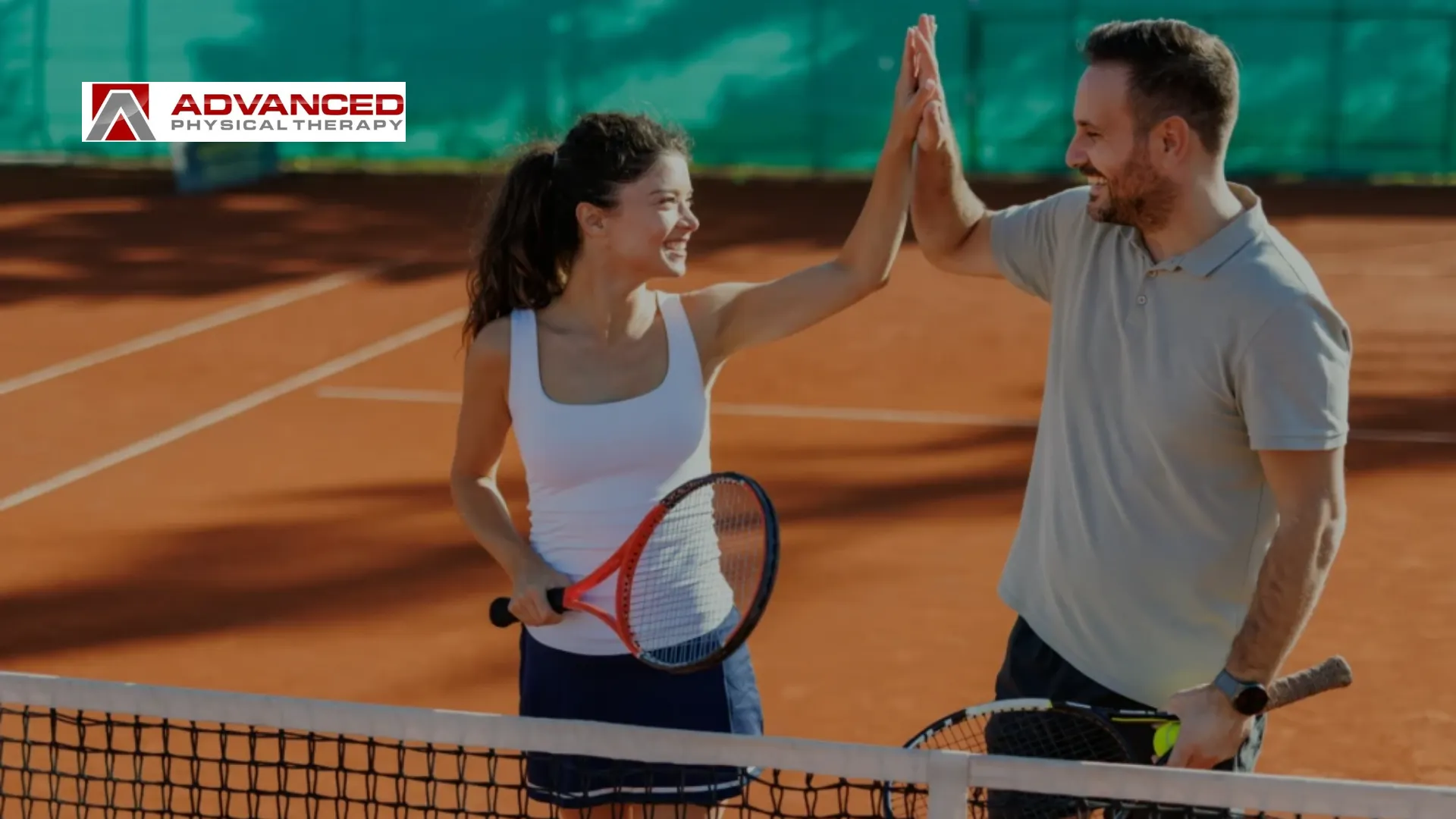
Sprains, strains, tendon injuries, and post-surgical knees and shoulders make up most of what sports physical therapy in Pinnacle Hills treats. A physical therapist rebuilds strength and control in the injured tissue, then measures whether the athlete meets objective standards before returning to competition.
Pinnacle Hills sits west of I-49 in Rogers and holds a dense cluster of gyms, golf facilities, and tournament venues that draw athletes of every age. Testing, not calendar dates, determines clearance.
What Is Sports Physical Therapy in Pinnacle Hills?
Sports physical therapy in Pinnacle Hills is rehabilitation built around a specific sport and a specific injury. Treatment restores range of motion, strength, and movement control, then progresses to sport-specific drills at competition speed. A therapist measures strength symmetry and landing mechanics to decide when the athlete is ready to compete again.
Key Facts About Sports Physical Therapy
- Sports physical therapy treats acute injuries and overuse injuries.
- Therapists measure limb strength symmetry to guide return-to-sport decisions.
- Blood flow restriction training builds strength when heavy loading is not yet safe.
- Athletes who return before meeting strength criteria face higher reinjury rates.
- Post-surgical ACL rehabilitation commonly spans nine to twelve months.
- Hamstring strains respond to eccentric strengthening rather than rest alone.
- Certified strength and conditioning specialists design the loading progression.
- Concussion recovery follows a stepwise activity progression supervised by a provider.
Which Athletes in Pinnacle Hills Get Injured Most?
Three groups fill the schedule. Adult recreational athletes make up the largest share, drawn from the gyms and studios along Pinnacle Hills Parkway and from golf at the country club nearby. Rotator cuff irritation, low back strain during lifting, and hip pain from repeated rotation dominate this group.
Youth club athletes make up the second group. Rogers hosts regional baseball, softball, soccer, and volleyball tournaments, and the volume of games compressed into single weekends produces elbow, shoulder, and knee complaints.
The third group is post-surgical patients. Knee and shoulder repairs performed at Northwest Arkansas surgical centers move into outpatient rehabilitation within days of the operation.
How Does Sports Rehabilitation Progress?
Rehabilitation moves through phases, and each phase has an exit requirement rather than a fixed length.
Phase One: Protection and Motion
Early care controls swelling and restores joint range of motion. Manual therapy and gentle activation keep the surrounding muscle working while the injured tissue settles.
Phase Two: Strength
Loading increases once motion is full and pain is controlled. Blood flow restriction training allows strength gains at light loads when the joint cannot tolerate heavy weight.
Phase Three: Power and Speed
Jumping, cutting, and throwing mechanics return under supervision. The therapist corrects landing patterns and deceleration, since those movements cause most non-contact knee injuries.
Phase Four: Return to Sport
The athlete completes sport-specific drills at full intensity and passes the testing battery before clearance.
What Testing Determines Readiness to Compete?
Clearance rests on measurement. Therapists compare the injured limb to the uninjured limb using isolated strength tests and hop tests, and most protocols look for the injured side to reach at least 90 percent of the healthy side.
Landing mechanics are scored on video. Sport-specific endurance is tested under fatigue, because movement quality breaks down late in games rather than early. Head injuries follow a separate route, and the stepwise return to play progression after a concussion requires the athlete to clear each activity level without symptoms before advancing.
How Long Until an Athlete Competes Again?
Timelines vary by tissue. Mild ankle sprains resolve in two to four weeks. Hamstring and groin strains commonly take six to eight weeks, with the final weeks devoted to sprint exposure. Rotator cuff tendinopathy improves over eight to twelve weeks.
Reconstructive knee surgery requires the longest course, and criteria for competition are rarely met before the ninth month. Athletes who skip the final testing phase account for a large share of repeat injuries.
Who Should Consider Sports Physical Therapy?
Athletes who feel pain that changes their mechanics need evaluation, since compensation creates secondary injuries. Other indications include a joint that gives way, swelling that returns after each practice, loss of throwing or serving velocity, and any injury that has kept an athlete out for more than a week. Athletes preparing for a season also use assessment to find strength deficits before those deficits produce injury.
Common Questions About Sports Rehabilitation
Can an athlete keep training during rehabilitation?
Most athletes continue training the uninjured parts of the body. The therapist adjusts the program so conditioning continues while the injured tissue heals.
Does sports physical therapy help performance as well as recovery?
Strength testing and movement screening identify deficits that limit output. Correcting them improves both durability and performance.
Is dry needling used for sports injuries?
Therapists at Advanced Physical Therapy use dry needling for muscle tension and trigger points that restrict motion in athletes.
How soon after surgery should rehabilitation begin?
Surgeons often start rehabilitation within the first week. Early motion protects the joint from stiffness that becomes difficult to reverse.
What Communities Does the Rogers Clinic Cover?
Athletes travel to the Rogers clinic from across Benton County:
- Pinnacle Hills (72758)
- Bentonville
- Cave Springs
- Lowell
- Little Flock
- Bella Vista
- Downtown Rogers
Planning a Return to Competition
An injury handled early usually costs an athlete less time than one played through. Athletes and parents weighing sports physical therapy in Pinnacle Hills can learn how Advanced Physical Therapy structures rehabilitation for each sport, and the Rogers office answers questions about evaluation timing at (479) 340-1100.